What Article 18 of the Security Bill Provides Article 18 was included in the Draft Law (later decree-law) “Security Bill”, with the declared intent of limiting the circulation of hemp flowers (even if derived from “legal” varieties) and their derivatives, when such products — according to the legislator — may have a psychophysical effect that endangers public or road safety. In particular, the text states that amendments are introduced to Law 2 December 2016, no. 242 (the law that regulated industrial hemp) with the addition of a “3-bis” paragraph which establishes: Therefore, formally, Article 18 intervenes by amending Law 242/16 to exclude flowers from the “industrial hemp” regime and to adjust the penalties for the latter. Critical Issues and Controversies 1. Conflict with European Legislation and TRIS Procedure One of the major points of debate is that Art. 18 imposes technical restrictions/regulations that affect the internal market, but it does not appear that the Government has notified the rule to the European Commission according to the procedure provided by Directive 2015/1535 (TRIS procedure). According to industry associations, this would make the rule unenforceable against citizens and businesses, by virtue of the principle of the primacy of European law (i.e.: a national regulation that does not comply with European procedures cannot be enforced). 2. Regulatory No Man’s Land — Legal Uncertainty 3. Conflict with the Purposes of Law 242/16 Law 242/16 aimed to promote the industrial hemp supply chain: cultivation, processing, uses not related to psychotropic effects. Article 18, by extending the ban to flowers (even legal ones), risks wiping out much of the practical applications in the “legal hemp” field. In parliamentary hearings and technical documents, industry operators and agricultural associations have pointed out that the new regime risks affecting investments, business projects, and the very credibility of the sector. Why Some Argue that Article 18 does not explicitly ban sales in every case Despite the apparent severity of the text, some interpret Article 18 in a non-absolute way, stating that it does not establish an insurmountable total ban on the sale of flowers in every circumstance. The main reasons: Conclusion: What Legal Scenario for Sales? Article 18 introduces a restrictive regime for hemp flowers, which risks excluding them from the “legal” market as it has been understood so far in the context of light hemp / legal CBD. However, its full effectiveness is subject to strong doubts: In summary: Article 18 could severely restrict the sale of hemp flowers, but it is not (at least at present) a rule that a priori prevents in every situation the marketing of products that are duly certified, free of intoxicating effect, and compliant with European regulations. Well-documented businesses can assert arguments of non-application and use legal tools to protect themselves in the evolving legal context.
The text provides that the intervention is justified “in order to prevent the consumption of products ... from favoring ... alterations of the psychophysical state ... behaviors that expose public safety or health to risk.”
This theoretically leaves room for the argument that, if a hemp flower is verified by analysis as free of any intoxicating effect, it would not fall within the scope of the ban.
It can be argued that, until the rule is notified and approved according to the TRIS procedure, it cannot legitimately be enforced against businesses operating in compliance with European law. In this sense, judges and law enforcement could disregard Article 18 in concrete cases.
The Supreme Court, in previous decisions, has specified that the mere presence of a potentially psychotropic substance is not sufficient, but the actual ability to produce narcotic effects must be assessed. If a flower is shown by laboratory evidence to be free of intoxicating effect, criminal relevance can be excluded.
There is the argument that Article 18 establishes a “normative principle”, which requires implementing regulations, ministerial guidelines, detailed rules, in order to be fully applied. Until then, its full application would not be immediate. Some associations argue that no clear implementing regulation has been prepared, thus leaving room for interpretation and protection for those operating in compliance with European law.
Article 18 focuses on “products consisting of hemp flowers or containing such flowers, including extracts, resins, and oils derived from them.”
It can be argued that derivative products, in which the flowering parts are deactivated, purified, isolated, or characterized so as not to contain active ingredients, could fall outside the restrictive scope, if adequately demonstrated.
Copyright © 2025 | ALL RIGHTS RESERVED WWW.CARLITOSWEED.AMSTERDAM
Article 18 of the Security Bill: what it provides and why it does not automatically ban the sale of legal cannabis
Article 18 of the Security Bill: what it provides and why it does not automatically ban the sale of legal cann
2025-10-04 11:00
2025-10-04 11:00
Array() no author 93111
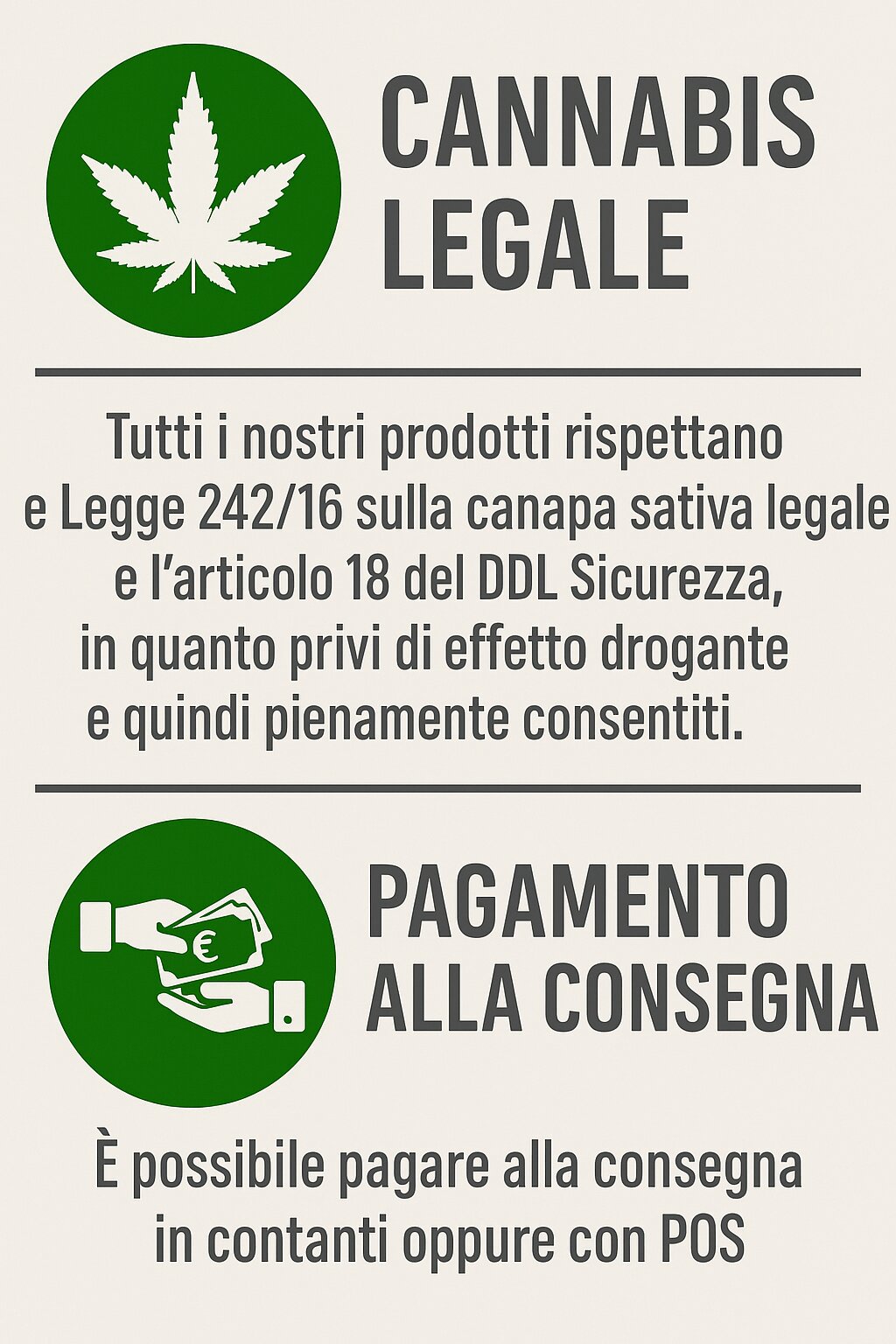
Article 18 of the Security Bill amends Law 242/16, but does not completely ban the sale of legal cannabis: products without effect remain permitted
Copyright © 2025 | ALL RIGHTS RESERVED WWW.CARLITOSWEED.AMSTERDAM