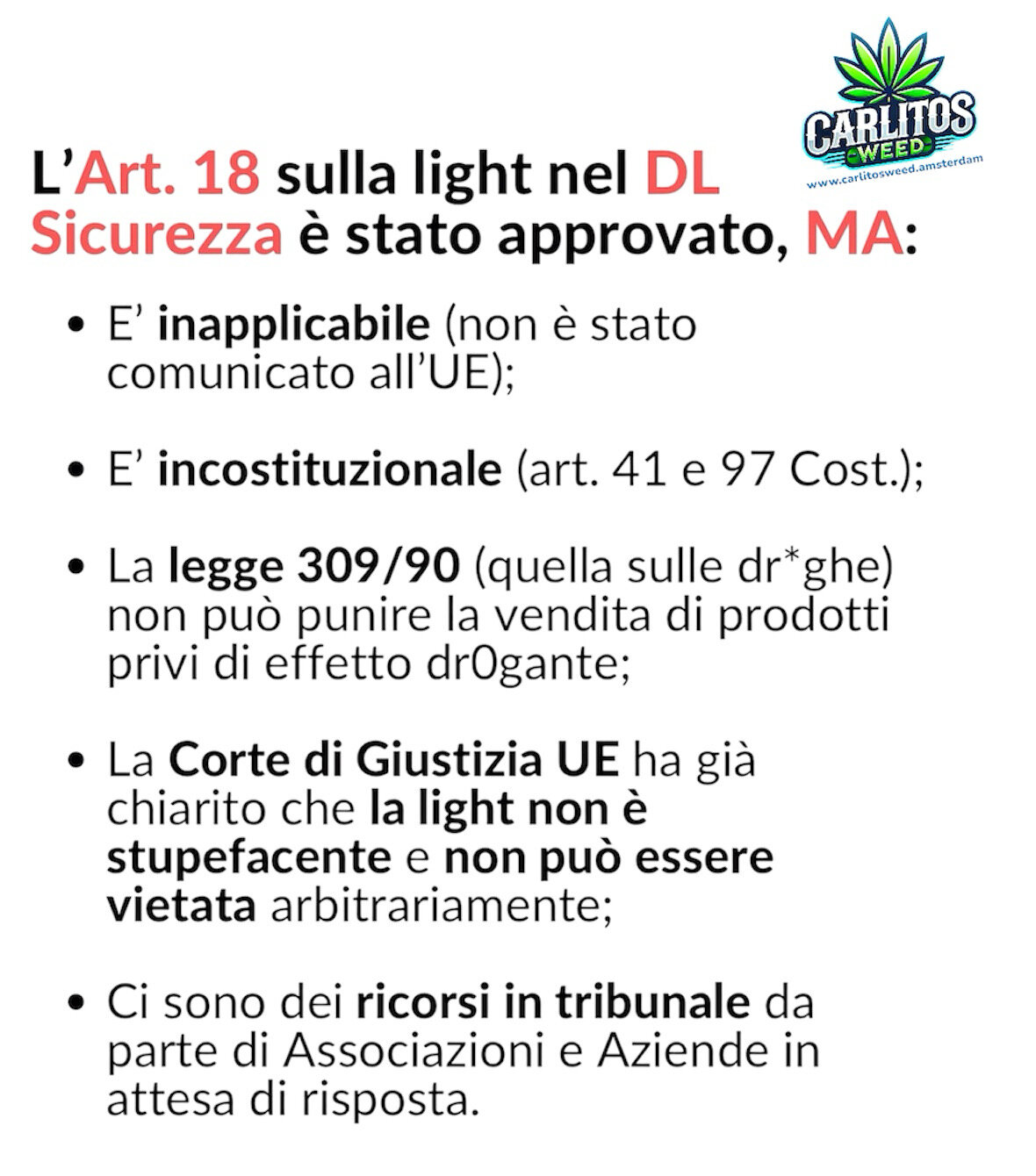
The war on light cannabis: how the State tries to criminalize what the courts protect Premise In recent years, the so-called “light cannabis” sector — that is, the production, sale, and marketing of hemp flowers or derivatives with low THC content, such that they do not have intoxicating effects — has found itself in an eternal limbo between “ambiguous tolerance,” arbitrary seizures, and judicial rulings that, step by step, have tried to defend the legitimacy of lawful activities. With the approval of Article 18 of the so-called Security Decree (DL 48/2025), the State has attempted to brutally clamp down on a sector that was already operating on thin legal boundaries. But the response from the courts has come, and in several cases has sided with operators in the legal hemp supply chain. In this article I will reconstruct the main favorable rulings — that is, “legal victories” — and show how the State’s prohibitionist approach is now out of sync with scientific reality, European law, and judicial practice. Brief regulatory framework: between laws, bans, and chaos The most significant rulings (the “favorable precedents”) Below are some of the judicial rulings that – for operators, lawyers, and citizens – are milestones in the battle for legal hemp: 1. United Sections of the Court of Cassation, judgment no. 30475/2019 This is certainly the most cited ruling. The United Criminal Sections of the Court of Cassation were called to resolve an interpretative conflict regarding the lawfulness of marketing flowers, leaves, resin, and other derivatives from low-THC hemp cultivation. What was decided: This decision is often used against sector operators, as an argument to reject their claims, but it has been contested — in subsequent rulings — that it is now inadequate in light of regulatory, scientific, and European interpretative developments. 2. Court of Trento, order of 5 September 2025 This is one of the most recent (and relevant) rulings against Article 18 of the Security Decree. According to media reports, the Court of Trento ruled that light cannabis without intoxicating effect is legitimate. The order states that the State cannot absolutely prohibit measures that are not based on rigorous scientific evidence. In other words, the Court qualified Article 18 as “merely declaratory” (i.e., not a substantial novelty) and reiterated that hemp remains legal when it does not produce intoxicating effects. 3. Maxi-investigation in Turin, dismissal (2025) In 2023, the Piedmontese judicial system (Turin) launched a maxi-investigation into light cannabis operators, alleging production, trafficking, and possession of narcotic substances. In the end, according to the latest media updates, the charges were dismissed because they were considered unfounded. This case shows how, in practice, investigations into crypto-operations in the sector can fail due to lack of concrete basis. 4. Court of Genoa (Review), 2019 The Review Court of Genoa ruled that it is not possible to preemptively seize flowers with THC below 0.5% unless it is proven that the threshold has been exceeded. This ruling puts a brake on automatic seizures “regardless,” requiring that the actual exceeding of the limit be demonstrated first. 5. The report of the Massimario of the Court of Cassation (23 June 2025) This is not a formal judgment, but the report of the massimario — which comments on and interprets the Court’s decisions — which criticized Article 18 of the Security Decree, calling it “unconstitutional” and in conflict with European law, because it imposes an absolute ban without adequate scientific justification. According to press reports, the report “tears apart” the ban on light cannabis, as if it were a legislative operation dictated by ideology rather than legal principles. Critical analysis: why does the State prohibit? In light of these favorable rulings, it is increasingly clear that the State’s prohibitionist behavior towards light cannabis rests on weak foundations:
Article 18 of the Security Decree proposes an absolute ban without distinction, i.e., it treats all flowers as narcotics, regardless of THC content and the actual effect on the subject. This is in contrast with the principle of “minimum punitive intervention” and the principle of proportionality.
Without certain scientific evidence that very low THC generates significant effects on public health, the total ban appears unreasonable.
In several cases, the EU Court of Justice has stated that the precautionary principle is not enough: to impose bans, the State must concretely demonstrate health risks. Some specialist articles also cite the Kanavape judgment (C-663/18) as an example in which it was ruled that CBD extracted from the plant cannot be considered a narcotic substance. (Note: many online sources claim this, but it should be checked carefully)
Furthermore, EU Member States must notify the Commission of any national measure that limits the free movement of goods, unless justified by “overriding reasons of general interest.” An absolute ban imposes a strong obstacle to intra-community trade, and it does not appear that the Decree has been notified to the EU (or that it complies with EU procedures). Some sources claim that art. 18 is not applicable because it was not communicated to the EU. (This aspect is often cited in sector posts)
The light hemp sector has grown in recent years, generating employment, agricultural diversification, enhancement of the territory, and an emerging market that is also growing in Europe. Prohibitionism, with seizures and uncertainty, blocks investments and drives away innovators.
The fact that a massive investigation (Turin) ended with the dismissal of charges shows that the State spends resources (law enforcement, judiciary, seizures) on cases that then prove to be unfounded.
If legitimate operators have relied on interpretations of the law or previous rulings to start activities, they cannot be turned into criminals retroactively by a decree that intervenes radically. The principle of legal certainty requires that criminal rules be clear, predictable, and not retroactive in the worst sense.
A severe ban that penalizes even those who operate with products with very low THC, without evidence that such products are dangerous, shows a lack of reasonableness and proportionality: the punishment must be commensurate with the actual harm or danger caused by the conduct, not an abstract suspicion.
Copyright © 2025 | ALL RIGHTS RESERVED WWW.CARLITOSWEED.AMSTERDAM

The war on light cannabis: how the State tries to criminalize what the jurisprudence protects
The war on light cannabis: how the State tries to criminalize what the jurisprudence protects
2025-09-24 17:04
2025-09-24 17:04
Array() no author 93111
“Judicial victories on light cannabis: how the State wants to criminalize what the jurisprudence protects”
Copyright © 2025 | ALL RIGHTS RESERVED WWW.CARLITOSWEED.AMSTERDAM